
01
Your table. Your rules.
Set up 2 to 8 players in seating order. Settings let you choose default players and house-rule scoring.

Android app capture. Tablet layouts differ.
 Spades Scorepad
Good company. Great game.
Less arithmetic. More one-more-round. A scorekeeping companion for the Spades game happening around your table.
Android phones & tablets iPhone & iPad
The little things, considered
You bring the cards and the company. Scorepad tracks the bids, tricks, bags and standings.
Real Android and iPhone screens, right beside the features they show. Tap a screen to enlarge it. The same scorekeeping features on both platforms, with layouts adapted for phones and tablets.
Set up 2 to 8 players in seating order. Settings let you choose default players and house-rule scoring.
Android app capture. Tablet layouts differ.
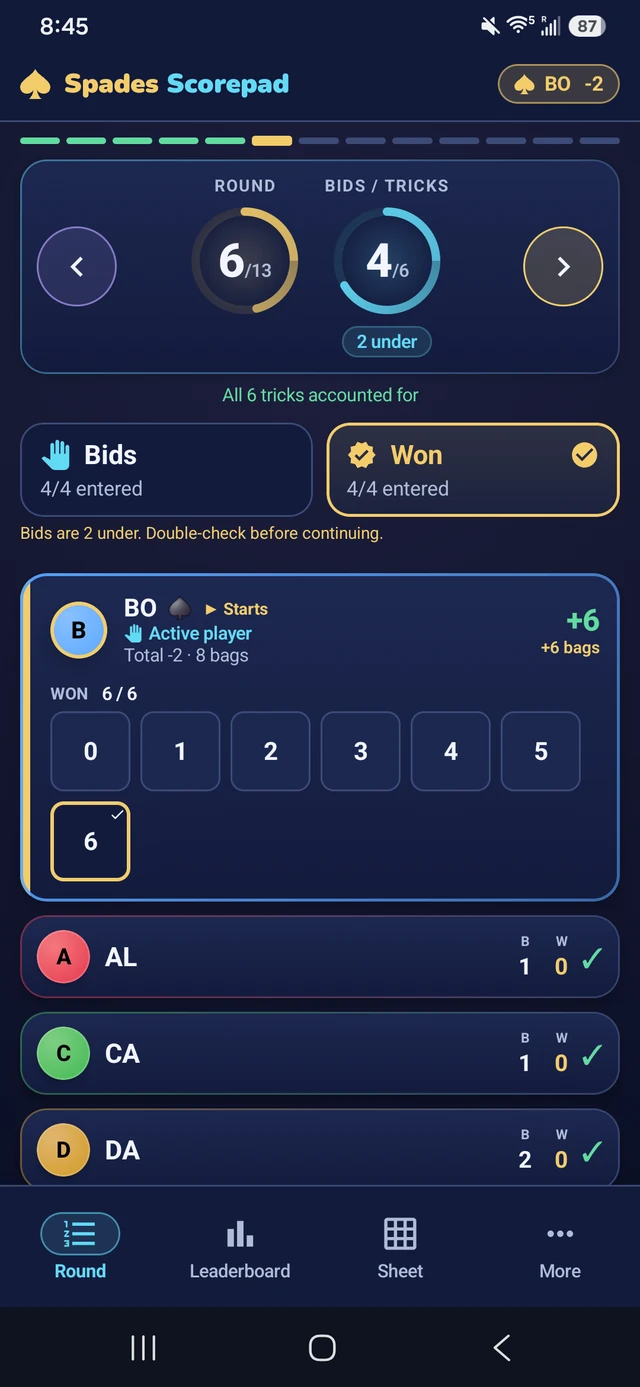
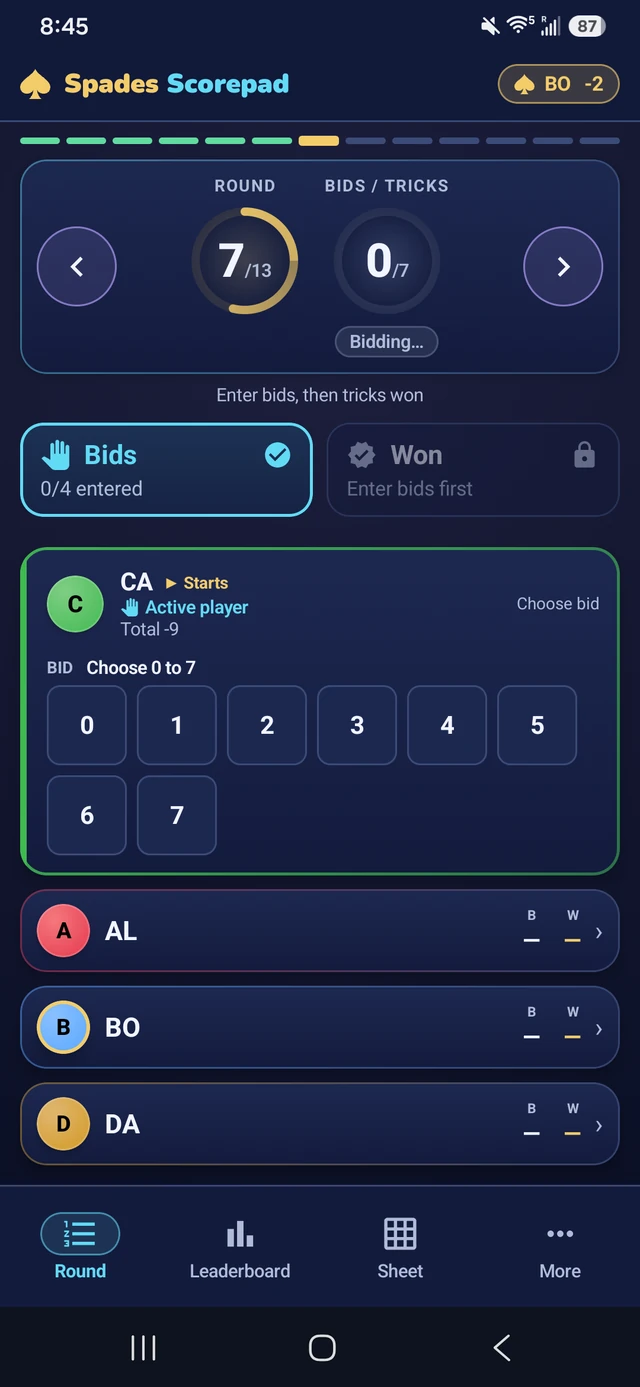
Record each player’s bid and tricks won with clear round-by-round entry.
Android app capture. Tablet layouts differ.
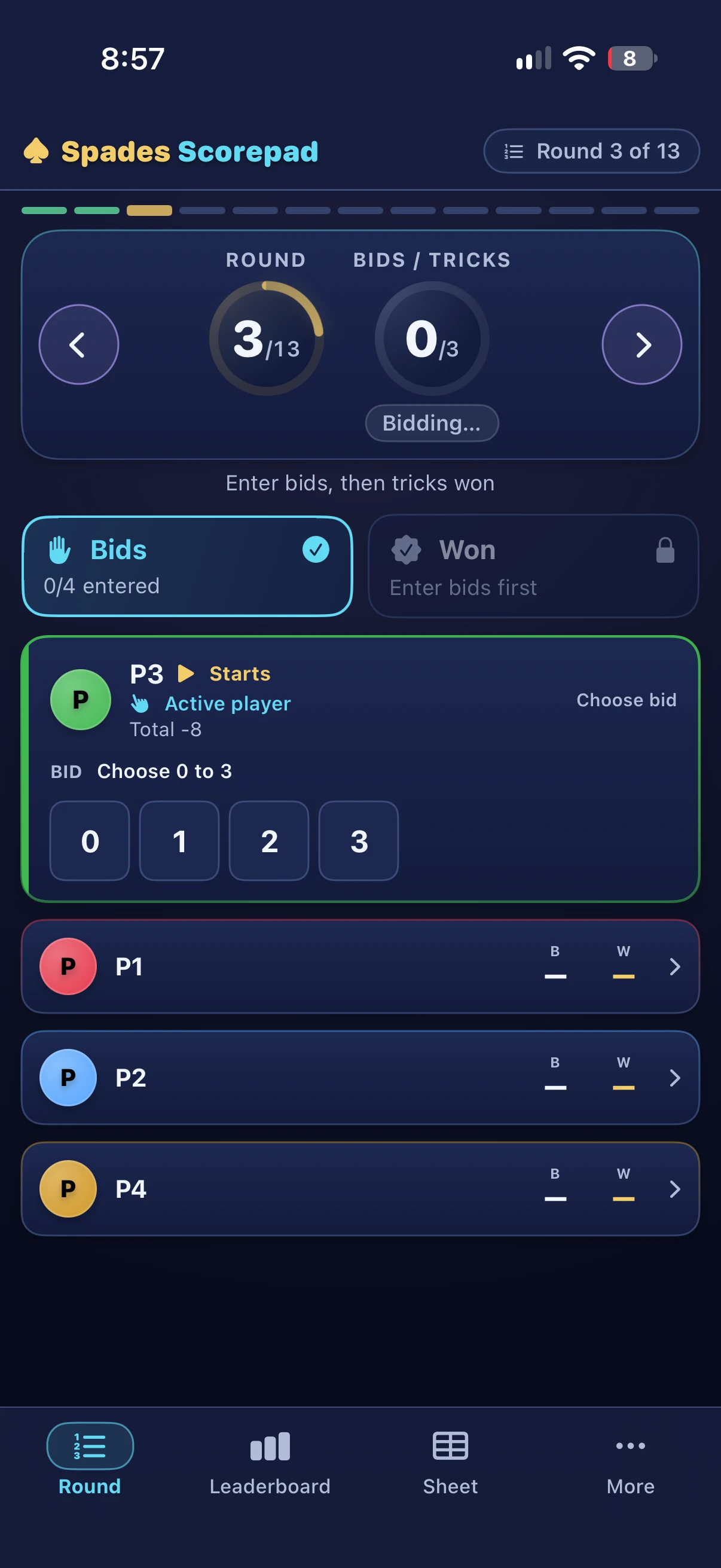
iPhone app capture. Tablet layouts differ.
Let Scorepad calculate scores and bag penalties using the app’s scoring rules.
Android app capture. Tablet layouts differ.
See who is ahead, compare scores and keep track of bags as the game unfolds.
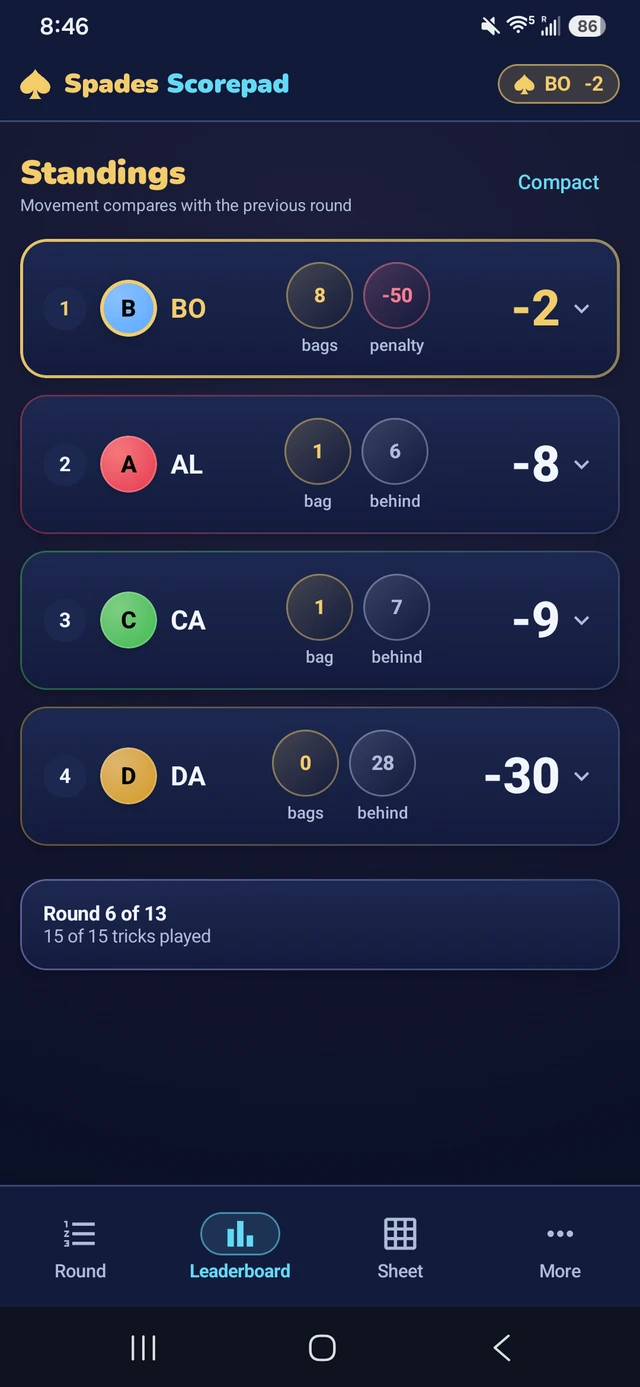
Android app capture. Tablet layouts differ.
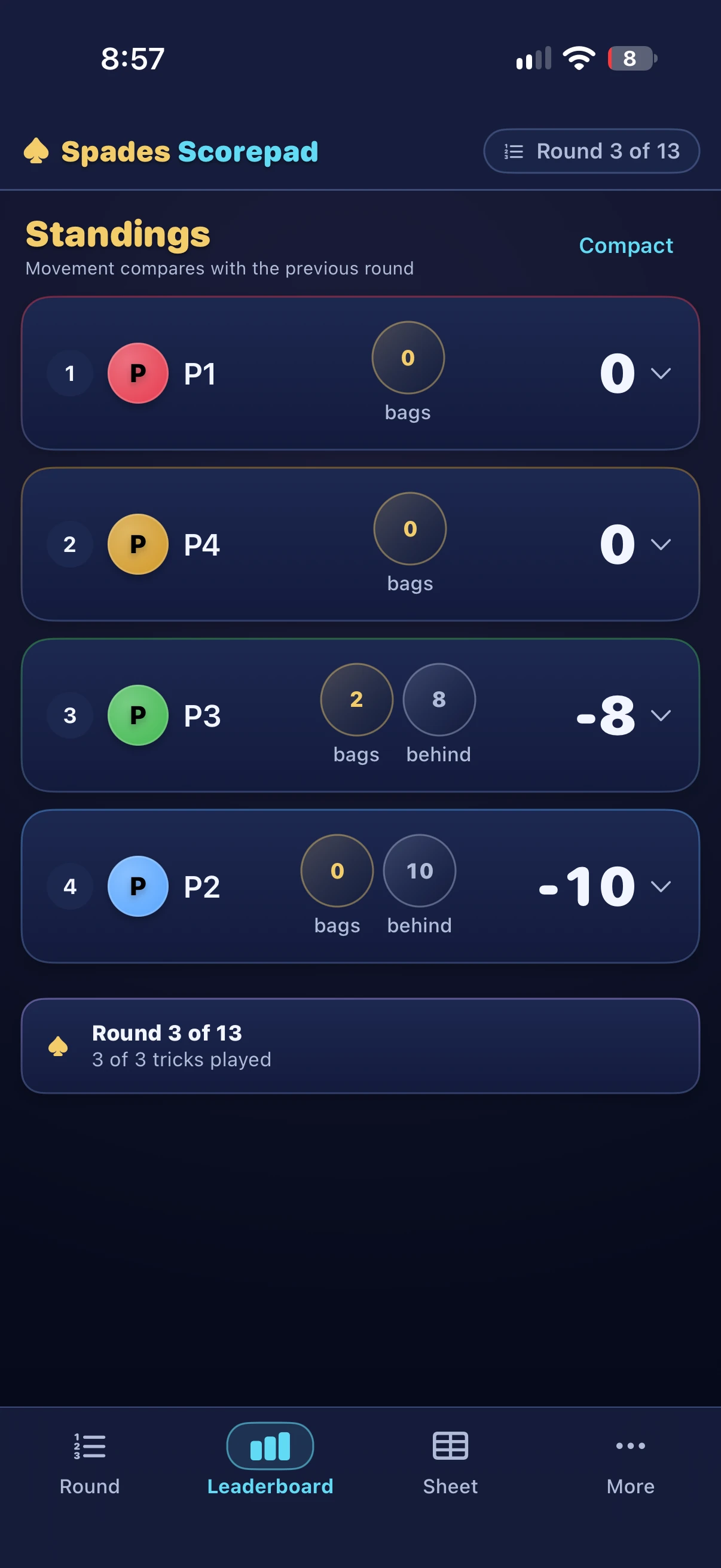
iPhone app capture. Tablet layouts differ.
Review the rounds together without losing the bigger picture of the game.
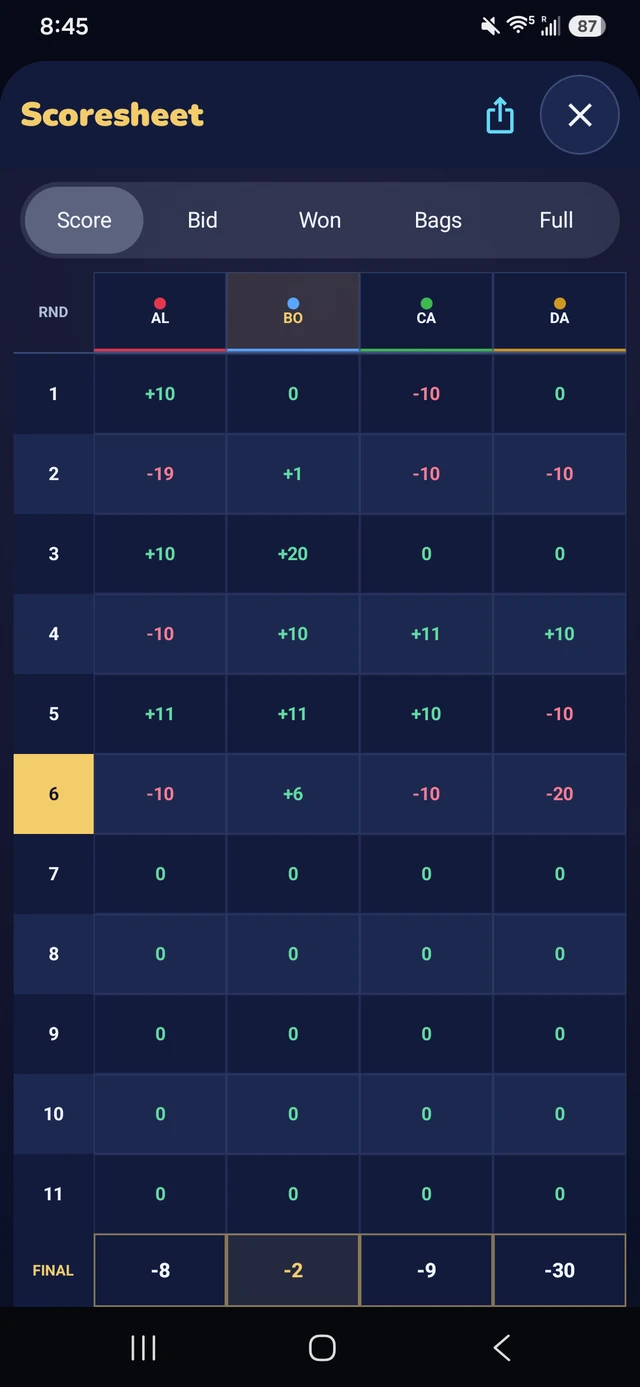
Android app capture. Tablet layouts differ.
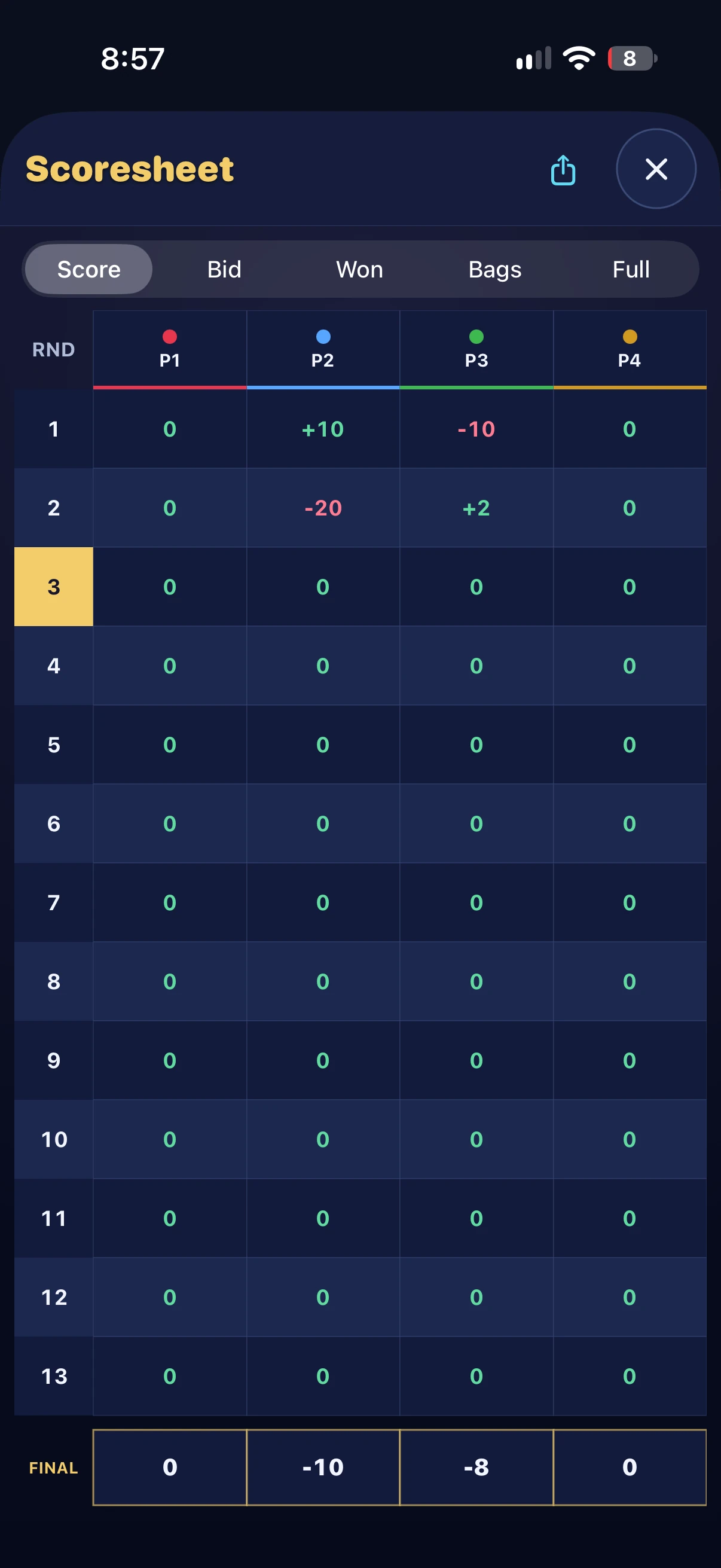
iPhone app capture. Tablet layouts differ.
The current game is saved on your device. Core scorekeeping works offline.
Use More > Export Game and Import Game for local backups.
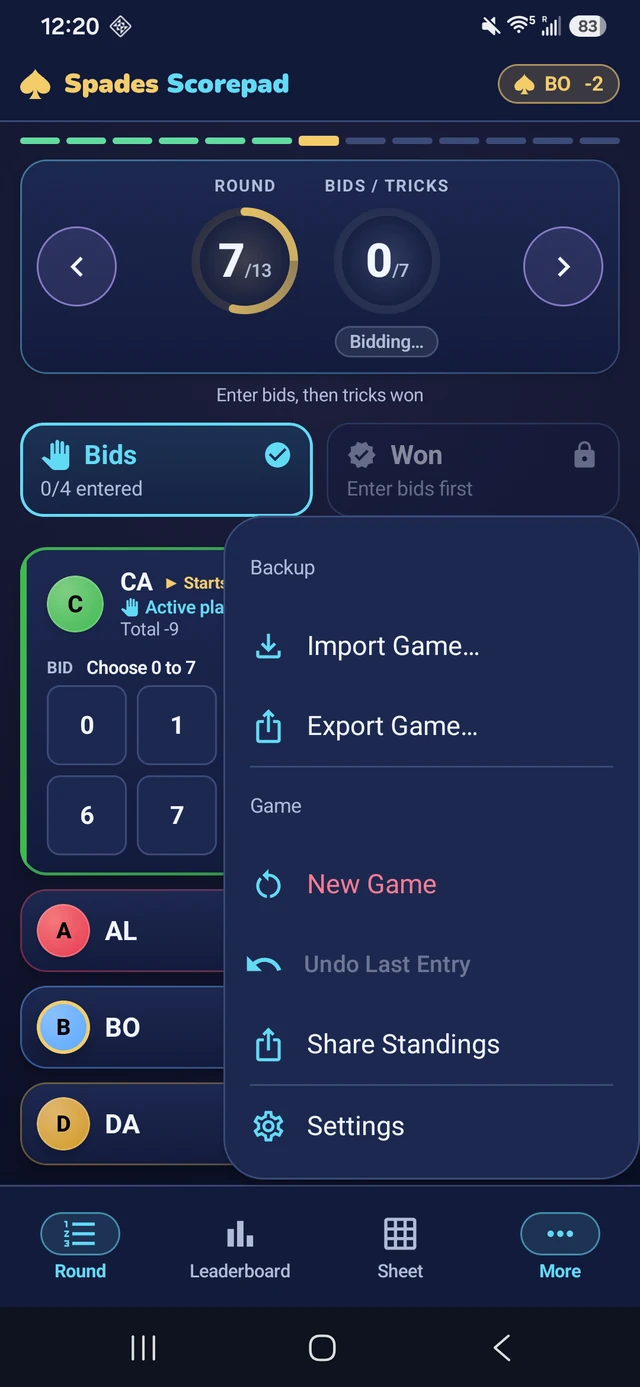
Android app capture. Tablet layouts differ.
The Scorepad playbook
A beginner's guide to Scorepad's 13-round, per-player format, not traditional partnership Spades.
Small hands. Bigger decisions.
Predict your tricks. Follow suit. Watch the bags. Each round adds another card to your hand and another twist to the table.
You play with your own cards. Scorepad records bids and tricks; it does not deal cards or play opponents.
See the rule. Remember the game.
It's the card you play, not the bid you make. A trick is one set of cards, not the whole round or match.
Spades played?The highest spade played wins the trick.
No spade played?The highest card of the running suit wins the trick. That's the suit led first.
Hearts were led, but the third and fourth players cannot follow hearts and play spades. Both spades beat the ace of hearts. The king is the highest spade played, so its player wins this trick and leads the next one.
Clubs were led, so clubs are the running suit. No spade is played. Ace is higher than king: the ace of clubs beats the king of clubs and wins this trick. The ace of hearts is not in the running suit, so it cannot win. Players without clubs may play another suit.
These are illustrated examples, not playable hands. You must follow suit when you can; you cannot choose a spade instead while holding a card of the running suit.
From first deal to final score
For an easy first game, start with four players and a standard 52-card deck, without jokers. Play individually. Agree on the dealer, first leader and any house rules before starting. Scorepad can track 2 to 8 players; larger tables need an agreed deck setup.
4 players. One deck. A great start.
Play 13 rounds. In round 1, deal 1 card to each player; in round 2, deal 2 each, and so on up to 13 each. Shuffle and deal a fresh hand every round. A round has as many tricks as cards in each hand.
1 to 13 cards per player.
Look at your hand and predict how many tricks you will win. Each player bids from 0 to the round number. Record the bids before playing. Total bids can be above or below the number of available tricks.
Bid 0 to the round number.
A trick is one card played by each player in turn. The running suit is the first card's suit. Follow the first card's suit if you can. If you cannot, play any card, including a spade. The highest spade played wins the trick. If no spade is played, the highest card of the running suit wins the trick. Ace is the highest card within each suit, above king, queen and jack, down to 2 low. The winner leads the next trick.
Follow suit. Spades are trump.
When the hand is finished, enter each player's tricks won, including any zeros. The total must equal the round number: round 7 has exactly 7 tricks to share across the table. Scorepad calculates each player's points and bags.
Round 7 = 7 total tricks.
Keep playing as the hands grow. Bags carry over between rounds, so extra tricks can come at a cost. After round 13, the highest final score wins. Final score is the sum of round points plus any bag deductions.
Highest final score wins.
The numbers, made simple
Meet or beat your bid: earn 10 points per bid trick, plus 1 point and 1 bag per extra trick. Miss your bid: lose 10 points per bid trick, then add the number of tricks you actually won.
Bid 3 Won 3
+30points10 x 3 = 30 points
0 bagsBid 3 Won 5
+32points10 x 3 + 2 = 32 points
2 bagsBid 3 Won 2
-28points-10 x 3 + 2 = -28 points
0 bagsZero is a valid entry. Bid 0 and win 0: score 0 points. This format does not award separate nil or blind-nil bonuses.
The penalty playbook
Missing a bid and collecting bags are different costs. Know both before the first deal.
Lose 10 points per bid trick, then add the tricks actually won. Bid 3 and win 2: -30 + 2 = -28 points. This is the round score, not a second deduction on top of it.
-28points in this exampleEach trick above your bid adds 1 point and 1 bag. Bags carry across rounds. Under Classic, every complete group of 5 bags costs 50 points from your running total.
-50per 5 bags under ClassicYour table. Your rules.
Classic is the initial default, but your saved setting may differ. Check the scoring preset in Settings before you start.
Classic example: 12 accumulated bags mean two -50 penalties: a total bag deduction of -100 points.
Penalties repeat, not just once. With 12 bags under Classic, 2 bags count toward the next penalty at 15; the displayed bag total remains cumulative. No Bag Penalty disables bag deductions only: a missed bid still loses points. Final score = round points minus bag penalties.
Changing the preset uses Apply & Recalculate and recalculates the whole recorded game, not just future rounds. Agree on any change with the table.
Less arithmetic. More one-more-round.
Try a round with four fictional players. Change the numbers and let the scorepad do the math.
Website scoring demo, not a playable card game or the app itself. Nothing is saved or sent. This is Scorepad's individual, 13-round format, not partnership Spades.
Each change includes only new bag deductions in this round. Earlier scores are not included; this is not the match leaderboard.
30 round points; 0 new bags (0 total); 0 bag deduction.
20 round points; 0 new bags (0 total); 0 bag deduction.
10 round points; 0 new bags (0 total); 0 bag deduction.
10 round points; 0 new bags (0 total); 0 bag deduction.
Meet your bid: 10 × bid + extra tricks. Miss it: -10 × bid + tricks won. A zero bid has no separate nil bonus. Bags stay cumulative; each new threshold triggers a deduction.
Changing the preset previews this round only. In the app, Apply & Recalculate updates the whole recorded game.
A little practice. A familiar rule.
Five quick challenges. Pick the winning card, discover the rule, then try the next trick.
Illustrated website rules quiz, not an app screenshot or a playable card game. Scorepad records your real game's bids and tricks; it does not deal cards or play opponents. Nothing is saved or sent.
Spades trump. Otherwise, the running suit wins. The highest spade played wins; without spades, the highest card of the suit led first wins. Ace is highest. Cards are numbered in play order; Player 1 led.
Assume every card was legally played: anyone playing off-suit has no card of the suit led. This quiz asks who wins, not which card you should play from a full hand.
Player 3: Two of spades wins this trick.
Hearts were led. The third player has no hearts and plays the two of spades. Even the lowest spade beats the ace of hearts, so Player 3 wins this trick.
Player 2: King of clubs wins this trick.
Clubs were led and no spade is played. The king is the highest club here, so Player 2 wins. The ace of hearts is off-suit and cannot win this trick.
Player 4: King of spades wins this trick.
Diamonds were led, but three players have no diamonds and play spades. The king is the highest spade played, beating the jack, three and ace of diamonds. Player 4 wins.
Player 1: Ace of spades wins this trick.
Spades were legally led and everyone follows suit. Ace is higher than king, queen and two. Player 1 wins this trick and leads the next one.
Player 3: King of hearts wins this trick.
Hearts were led. No spade is played, and neither off-suit ace can win. The king beats the ten of hearts, so Player 3 wins. Only the running suit matters when there is no trump.
Five tricks. One useful rule.
0 of 5 first choices correct.
Spades first. Otherwise, follow the running suit. The winner takes this trick and leads the next one, not necessarily the round or match.
Choose a card to reveal the answer. Only your first choice counts for each trick.
Two of spades wins. Hearts were led. The third player has no hearts and plays the two of spades. Even the lowest spade beats the ace of hearts, so Player 3 wins this trick.